Yes, I need to finish the Alaska/Canada posts, but I am interrupting those to journal our trip to Europe. Because as if the summer traveling Alaska and Canada wasn't enough, we also had a 3-week trip to Europe as well! Covid interrupted all plans, so we ended up with both trips in the same year. We have had a total blast on these trips, but I will admit that it's nice to be home and get back into a settled routine.
So two weeks after arriving back in Florida, we departed Tampa to fly to our starting destination, Prague. We had 3 segments: Tampa to Atlanta to Paris to Prague. We started the journey October 4.
After being in airports for 24 hours, we finally made it to Prague. Full disclosure: air travel is no fun whatsoever. I haven't flown anywhere since 2016 and I thought it was bad then 😂.
Anyhow, it went mostly smooth except for the itty bitty seats and crying baby behind us for, of course, the 8-hour leg. A short delay in departure at Charles de Gaulle airport but no worries. We had actually arranged our flights to give us plenty of time there as we had to take the airtrain from terminal to terminal, go through passport control - as we were coming from a nonShengen country to a Shengen country - and then go through security - and our USA TSA precheck status does not help outside of the USA. And with his new knee and implanted heart monitor, Al sets off all the alarms 😂.
We arrived October 5 in Prague, Czech Republic, for three nights, staying at the Augustine Hotel. It's beautiful, actually inspired by and a part of the 13th century Augustine monastery which is interconnected with the hotel and has 4 monks still active there. They offer a tour of the monastery and the 13th century library together with the baroque St. Thomas Church, and I'm sure we'll find time for that.
Tomorrow we have a morning walking tour called Panoramic Prague, then the afternoon is free, and then we have a dinner cruise on the Vltava River that flows through the middle of the city. But first, sleep was needed!


Building from 1560
A highlight of our tour this morning was the Prague Astronomical Clock. From Wikipedia:
The Orloj is mounted on the southern wall of Old Town Hall in the Old Town Square. The clock mechanism has three main components — the astronomical dial, representing the position of the Sun and Moon in the sky and displaying various astronomical details; statues of various Catholic saints stand on either side of the clock; "The Walk of the Apostles", an hourly show of moving Apostle figures and other sculptures, notably a figure of a skeleton that represents Death, striking the time; and a calendar dial with medallions representing the months. According to local legend, the city will suffer if the clock is neglected and its good operation is placed in jeopardy; a ghost, mounted on the clock, was supposed to nod its head in confirmation. According to the legend, the only hope was represented by a boy born on New Year's night.
The oldest part of the Orloj, the mechanical clock and astronomical dial, dates back to 1410, when it was created by clockmaker Mikuláš of Kadaň and Charles University professor of mathematics and astronomy Jan Šindel. The first recorded mention of the clock was on 9 October 1410.[4] Later, presumably around 1490, the calendar dial was added and the clock facade was decorated with gothic sculptures.
In 1629 or 1659 wooden statues were added, and figures of the Apostles were added after a major repair in 1787–1791. During the next major repair in the years 1865–1866 the golden figure of a crowing rooster was added.
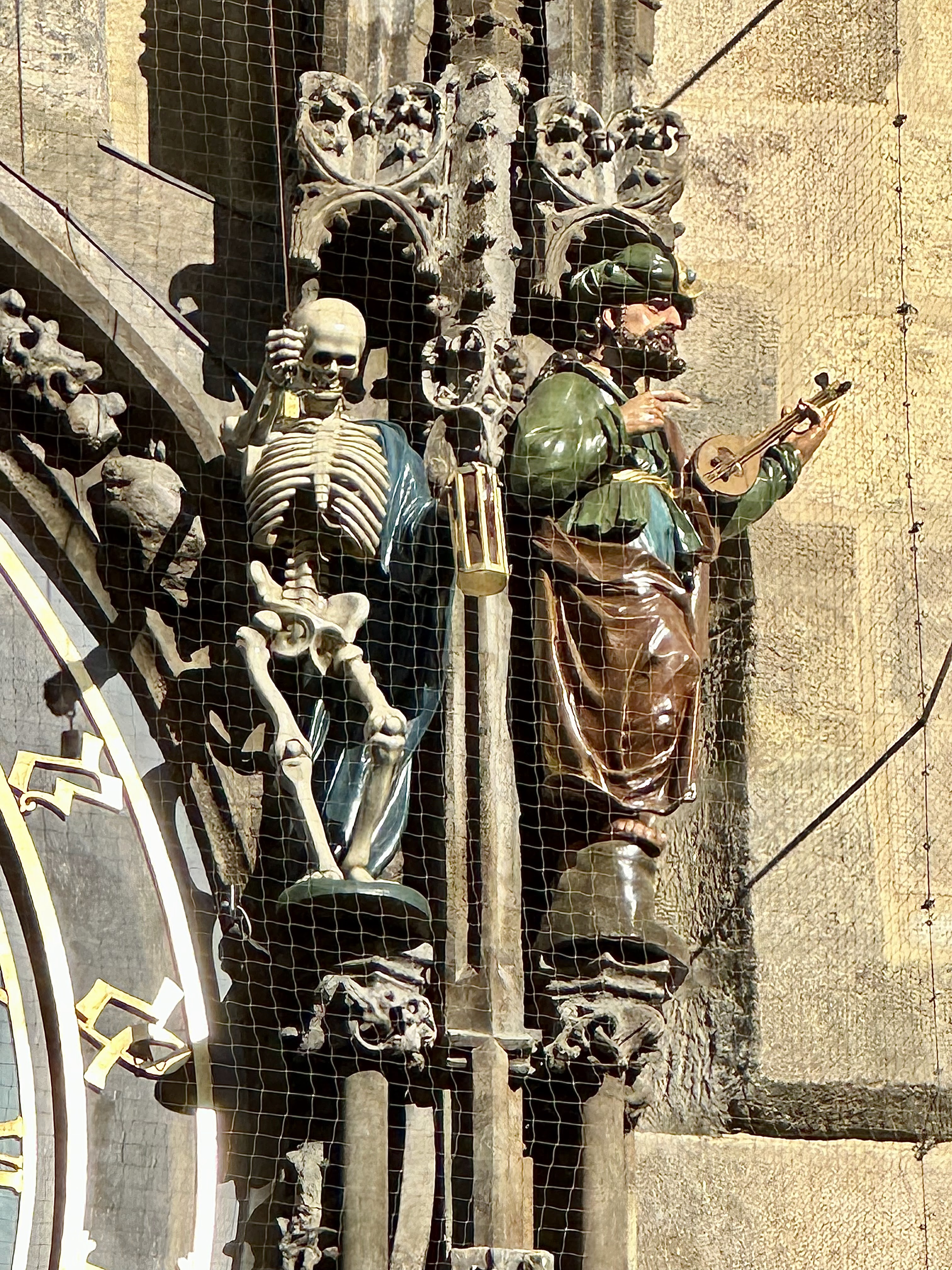
The netting surrounding the structure is in place to protect it from pigeons!
Wooden figures on the right side. Every hour the Walk of the Apostles occurs. The skeleton actually tolls the bell.
Year-round outdoor market that’s been in existence since 1232…can you imagine!?
Another highlight of yesterday’s tour of Prague is the Charles Bridge. Charles Bridge is the oldest bridge still standing over the Vltava river in Prague and the second oldest bridge in the Czech Republic. Charles IV had it built in 1357, after the previous bridge (had been destroyed by floods in 1342. The construction of the bridge was led by Peter Parler (“Petr Parléř” in Czech), the famous German-Czech architect, and it took almost half a century to finish it (It was completed in 1402). The bridge, formerly known as “Stone” or “Prague”, has only been called “Charles Bridge” since 1870. And until 1841 it was the only bridge over the Vltava river in Prague.
Charles Bridge, spanning the Vltava river with 16 pillars, is rich in statues and decorative lamps, and it catches the eye immediately with its beautiful Gothic bridge towers on both ends.
The tower end leading to Old Town Prague and the Jewish Quarter.
The statue of Charles IV is an outdoor sculpture of Charles IV, Holy Roman Emperor, located at Křižovnické Square in Prague, Czech Republic.
There are 30 statues attached to the balustrade of the King Charles Bridge. The oldest unrestored statues are almost black, while the cleaned restored statues are tannish in color.
The end of the bridge leading to the newer section of Prague and the majority of the government buildings.
under the bridge is lovely as well.
John Lennon Wall. Located in a small and secluded square across from the French Embassy, the wall had been decorated by love poems and short messages against the regime since 1960s. It received its first decoration connected to John Lennon—a symbol of freedom, western culture, and political struggle—following the 1980 assassination of John Lennon when an unknown artist painted a single image of the singer-songwriter and some lyrics.[1]
In 1988, the wall was a source of irritation for Gustáv Husák's communist regime. Following a short-lived era of democratization and political liberalization known as the Prague Spring, the newly-installed communist government dismantled the reforms, inspiring anger and resistance. Young Czechs wrote their grievances on the wall and, according to a report of the time, this led to a clash between hundreds of students and security police on the nearby Charles Bridge. The liberalization movement these students followed was described as Lennonism (not to be confused with Leninism), and Czech authorities described participants variously as alcoholic, mentally deranged, sociopathic, and agents of Western free market capitalism.
Prague new town landscape from Charles Bridge. The castle on the hill is a separate district that we had hoped to tour, but the EU annual summit meeting is taking place this week and the district is closed to everyone not associated with the meeting.
Trdelník is a kind of cake. It is made from rolled dough that is wrapped around a stick, then grilled and topped with sugar and walnut mix. Of course having ice cream served in the hollow center only makes it more irresistible 😊
The King Charles Bridge at night as seen from our dinner cruise.
The Castle District at night.
Today we became more serious and took educational tours. The morning tour was called “Jewish Prague” and focused on the history of the extensive Jewish population.
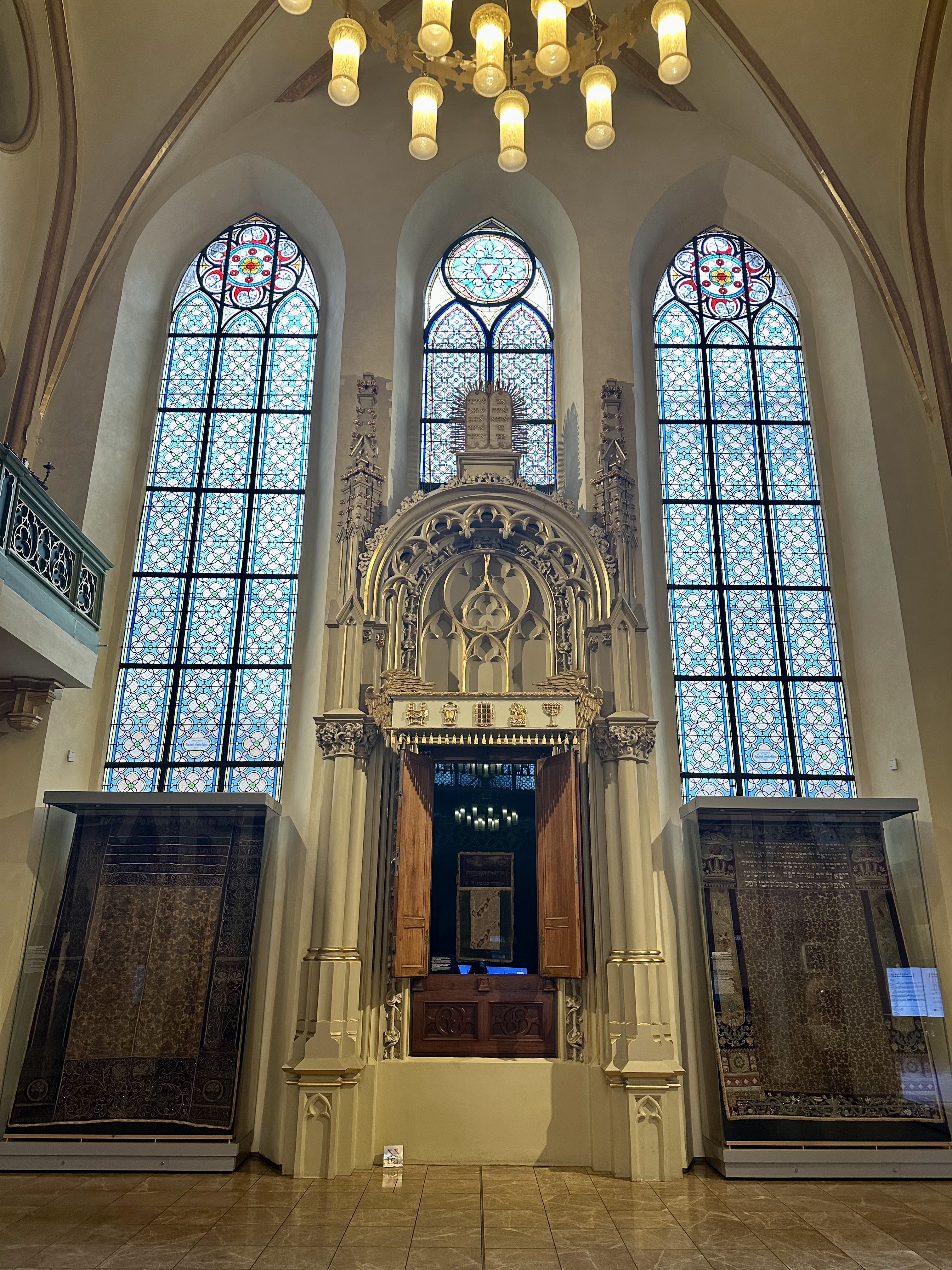
Jewish Quarter, also known as Josefov, is one of the most popular tourist destinations in Prague, located between the Old Town Square and the Vltava River. A Jewish ghetto was established here in the 12th century. At the turn of the 19th century, a large part of the ghetto was demolished. Fortunately, most of the significant buildings were saved from destruction and today, they represent the best preserved complex of historical Jewish monuments in Europe.
The afternoon tour focused on the effects of WWII on the Czech Republic and Prague.
I’ll try to put some of what we learned in the captions.
Both tours were very interesting and led by very well-informed guides. So far, I’m very impressed with the quality and wealth of knowledge that is imparted to our groups through these excursions.

The Jewish Town Hall was basically built for the purposes of the Jewish community to provide offices for its employees. The synagogue next to the Jewish Town Hall is called the High Synagogue.
There are actually two clocks. Up on the tower there is a regular clock, and we heard the bells ringing, and down here is a Hebrew clock, which is very specific, as you have mentioned, because it goes from the right to the left.
The synagogue next to the Jewish Town Hall his called the High Synagogue.
As you can see, the three large Renaissance windows are on the first floor. That’s why it’s called the High Synagogue, because the first services were always held on the first floor, not on the street level.
The Spanish Synagogue is not the first synagogue at the site. Before it there stood probably the oldest synagogue in Prague Jewish Town, Altschule. In the second half of 19th century, the capacity of the Altschule did not suffice. The modernist faction in the community, which renovated it in 1837 for the purpose of moderately reformed services, therefore decided to demolish the synagogue in 1867 and one year later it was replaced by the new, Spanish Synagogue. Its name presumably refers to the style in which it was built, Moorish Revival style

The Prague Holocaust Memorial. Carved into the walls are the names, date of birth, date of deportation, and date of death and which concentration camp of each victim of the Nazi genocide. statistics: For the Czechs of the Protectorate Bohemia and Moravia, German occupation was a period of brutal oppression. The Jewish population of Bohemia and Moravia (117,551 according to the 1930 census) was virtually annihilated. Many Jews emigrated after 1939; approximately 78,000 were killed. By 1945, some 14,000 Jews remained alive in the Czech lands.[5] Approximately 144,000 Jews were sent to Theresienstadt concentration camp. Most inmates were Czech Jews. About a quarter of the inmates (33,000) died in Theresienstadt, mostly because of the deadly conditions (hunger, stress, and disease, especially the typhus epidemic at the very end of war). About 88,000 were deported to Auschwitz and other extermination camps. When the war finished, there were a mere 17,247 survivors. There were 15,000 children living in the children's home inside the camp; only 93 of those children survived.

Old Jewish Cemetery, one of the oldest surviving Jewish burial grounds in the world. No one knows when it was exactly established but the earliest known gravestone dates back to 1439 and belongs to Rabi Avigdor Kara, who as a young man, was one of the witnesses of the cruellest pogroms against the Jews in the history of Prague, which took place in 1389.
We traveled with our cousins, Bill and Denise, and their daughter Erin. We had a wonderful time!
Sampling lunch items at a cafe in Old Towne.
The Powder Tower is one of the original 13 city gates in Old Town, Prague. Its construction began in 1475. The tower was intended to be an attractive entrance into the city, instead of a defensive tower. The gate was used to store gunpowder in the 17th century, hence the name Powder Tower.
These are stumble stones, markers place in the sidewalk in front of a deported Jew’s residence. It commemorates their name, date of birth, deportation, and death at which concentration camp.
The residence of the family members memorialized in the above stumble stones. You can see them in the bottom right corner.
The afternoon tour was about the Czech Resistance to the Nazi occupation during WWII. The major story was about Operation Anthropoid, which is a long story that can be read about here: https://en.m.wikipedia.org/wiki/Assassination_of_Reinhard_Heydrich
It was a deep-dive into the politics of the time which was extremely interesting. At the end of the historical lead-up to why the resistance rose, we visited the church where the brave young men were hiding after the assassination attempts and where they were ultimately found and executed.
Parting photos from our last evening.
Sampling Czechen beer
Next up: Travel to Budapest, Hungary, where we board our Viking longboat, the Skadi, for our 15-day river cruise.




















.JPG)


