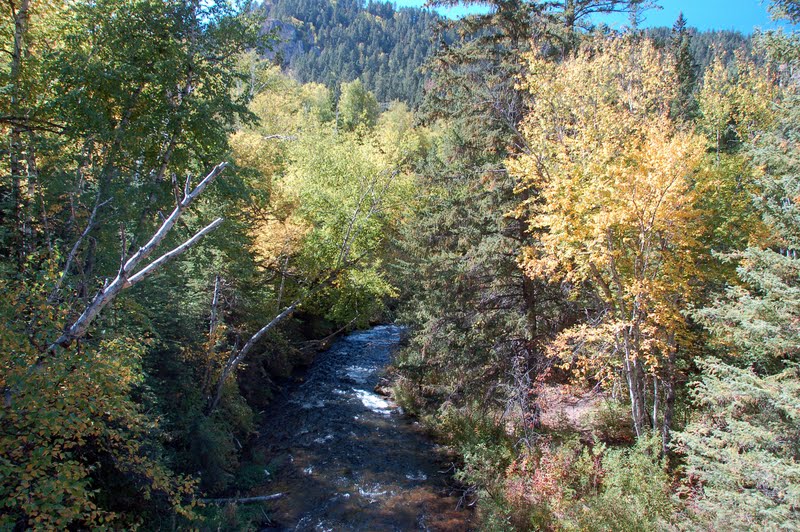
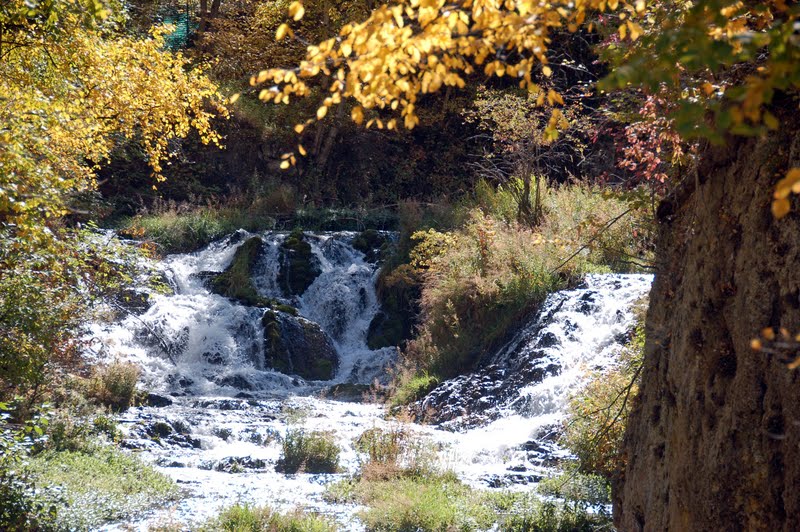
Welcome to our Adventure!

Al and I are thrilled that you have found your way to our blog. We hope you enjoy reading our journal and viewing our photographs of the natural wonder of our United States of America. Let's hit the road together!
Homer, Alaska

Wednesday, September 19, 2012

It's Tiring being a Tourist!

We've spent the last several days visiting as many sights in the Black Hills of South Dakota as we can in the few days we have in between jobs, and let me tell you I don't know how we use to have the energy for doing this back in our previous life!

Monday was very chilly here, cloudy and in the 50's all day, so we delayed our plans to drive Custer State Park, and went to do some inside activities. We first drove to Hot Springs, S.D. to visit the Mammoth Site. On the way there, we found a few big guys hanging out on the side of the road.

The Mammoth Site in Hot Springs is the world's largest mammoth research facility. More than 26,000 years ago, large Columbian and woolly mammoths were trapped and died here in a spring-fed pond near what is now the southwest ledge of Hot Springs, S.D. The bones lay here undiscovered until a developer bought the property in 1974. While excavating the land in preparation for a housing development, the bones were discovered and fortunately, not ignored. To date, 59 individual mammoths have been identified, with countless more waiting to be discovered. The excavation site is now enclosed, and paleontologists from around  come to assist at the dig and further research into these huge animals.

The sinkhole, called a "karst" formed over 26,000 years ago, was 65 feet deep and approximately 120 feet by 150 feet in size. The walls were steep sided, and the animals, enticed by the warm water and pond vegetation, came down into the karst but then found themselves unable to get back out.

Trapped in the pit, the animals eventually dies of a combination of exhaustion, starving and drowning.

The watering hole, active for about 350-700 years, slowly filled with layers of drying silt, sediments, and dying mammoths. The mud, which had aided in trapping the mammoths, now entombed and preserved the mammoth remains.

Eventually the sinkhole filled, and the artesian spring diverted to the lower elevation of Fall River, as the river cut deeper in the valley floor. Over thousands of years, the "hardened mud plug" inside the dried-up pond has remained stable. The surrounding dirt, the soft red Spearfish shale, ultimately eroded, leaving the sinkhole a hill.


Today's visitors can view the dig itself on a 30 minute tour, given by one of the guides in the research area. It was very interesting. These skeletons are not petrified, but actual fossils, and takes a painstaking amount of preparation and care for them to be discovered, cataloged and researched. There is also a short movie on the history of the site, and many recreated exhibits inside the museum area. It was definitely a worthwhile excursion and we enjoyed it very much.

After having some lunch, we drove to our second adventure for the day, Wind Cave National Park. On January 3, 1903, President Theodore Roosevelt signed the bill creating Wind Cave National Park. It was the eighth national park created and the first one created to protect a cave. The parklands at that time were small and there were no bison, elk, or pronghorn. They came later as the park boundaries expanded.In 1912, the American Bison Society was looking for a place to reestablish a bison herd. Because of the excellent prairie habitat around the park, a national game preserve was established bordering Wind Cave. It was managed by the U.S. Biological Survey. In 1913 and 1914, the animals began to arrive. Fourteen bison came from the New York Zoological Society, 21 elk arrived from Wyoming and 13 pronghorn came from Alberta, Canada.

Driving through the parklands to the visitor's center we saw a few of these fellows! At he visitor's center, we signed up for the 3:30 cave tour, and in the meantime, while waiting for the tour to start, took the dogs on a mile walk along the Prairie Ridge Trail...this National Park actually allowed you to walk the dogs on a trail!

The prairie vistas were beautiful...looks just like scenes from "Little House on the Prairie!"

Some curious deer followed our progress down the trail.


There is a faint trail leading through the grasses!

After securing the pups in the truck...in the shade, windows down, water bowl available...it was a cold day so they were fine!...we arrived for our tour. We were taken first to the only natural human-sized entrance to the cave. This is the entrance that Jesse and Harold Bingham found in 1881. They had been attracted to the area by a whistling sound, and upon discovering the entrance, found it by having their hats blown off their heads by the force of the wind coming out of the hole. Upon returning a few days later to show the phenomenon to their friends, they were  shocked to find the wind had reversed, and this time sucked their hats INTO the cave.

The McDonald family bought a mining claim in 1890 that contained this land, and as the claim never amounted to anything, they discovered they could make money by giving tours of the cave and selling some of its unique formations. Alvin McDonald, the son, at 16 years old, spent much of his time exploring and mapping the cave, faithfully keeping a diary and making a map of his findings. On January 23, 1891, Alvin wrote that he had "given up finding the end of Wind Cave". In the summer of 1891, business was improving and more modifications to the cave were needed. A man known as "Honest John" Stabler formed a partnership with the McDonalds. The two families created the Wonderful Wind Cave Improvement Company. Cave passages were widened and wooden staircases were installed. A hotel was built near the cave entrance and a stage coach provided rides to the cave.During the fall of 1893, J.D. and Alvin McDonald went to the Columbian Exposition in Chicago to advertise the cave. On the trip Alvin caught typhoid fever and was never really well again. He died that year at the age of 20. Shortly after Alvin's death, things began to go sour for the Wonderful Wind Cave Improvement Company.

The McDonalds accused the Stablers of keeping profits for themselves and demanded additional money.
Meanwhile Peter Folsom had gained control of the mining claim on the cave. Folsom and the Stablers joined forces against the McDonalds in court with both sides trying to prove that the other party had no claim to the cave. In December 1899, the Department of the Interior decided that since no mining nor proper homesteading had taken place, neither party had any legal claim to the cave. In 1901, the land around the cave was withdrawn from homesteading. It was two years later that President Roosevelt signed the papers creating it as a National Park.

The cave tour is about a mile and a quarter long, and takes a little over an hour to do. Its very different in that it never really opens up into large rooms like most caves do. The passageways are all very thin corridors. There are currently 138 miles of passageways mapped out in a very small space, with unknown numbers still left to be explored and mapped.

Small, knobby growths of calcite on the cave walls are called cave popcorn. Popcorn commonly forms in one of two ways in the cave: where water seeps uniformly out of the limestone wall and precipitates calcite; or, when water drips from the walls or ceilings of the cave and the water splashes on the floor or on ledges along the walls. This splashing action causes loss of carbon dioxide and the subsequent precipitation of calcite.

The most famous and prominent feature of the cave is called boxwork. Boxwork is made of thin blades of calcite that project from cave walls and ceilings, forming a honeycomb pattern. The fins intersect one another at various angles, forming "boxes" on all cave surfaces. Boxwork is largely confined to dolomite layers in the middle and lower levels of Wind Cave. When Alvin McDonald started taking people on tours, they also broke off these fins and sold them as souvenirs, figuring they would grow back quickly. Not so, Sherlock! So they stopped doing that, fortunately, and today we still have beautiful examples of it in this cave system.

Close up view of the boxwork

After our tour ended, we retrieved the pups from their nap, and took another hike in the park, the Elk Ridge Trail. Another beautiful walk through the rolling plains.

On the way home we found a few buffalo!

A couple were nice enough to pose near the sign so we won't forget where we were :-).

Traffic comes to a complete halt...not a good idea to hit a buffalo!

One last shot, up close.

It was a fun day, and a late dinner by the time we got back to the campground. We popped into bed early, as we had a spectacular drive coming up the next day....the Wildlife Loop, Iron Mountain Road, and the Needles Highway, as well as the first sighting up Mount Rushmore along the way. So come on back for the next installment :-). 

Sunday, September 16, 2012

Devils Tower Loop

One of our favorite movies from our teenage years was Stephen Spielberg's "Close Encounters of the Third Kind". It was even showing on AMC Friday night, and yes, we caught the last half of it. It only seemed fitting as we had decided to go and visit the actual Devils Tower the next day :-).

We had made arrangements to meet up with Laura, a friend of ours from Amazon, at the welcome center outside of Sundance. She has worked as a camphost at Cook Lake Recreation Area during the summers for the last ten years. When I found out she was still in the area, we decided to spend the day together. She is headed to Campbellsville soon, as she starts a month before we do.

On the ride over to Sundance from Spearfish, we stopped at an attraction called the Vore Buffalo Jump. I wasn't sure what it was, but the interpretive displays explained it all. Buffalo was a primary staple of the Plains Indians, but naturally they were very dangerous to hunt. The Indians ingeniously used this natural sinkhole as an aid to hunting the buffalo.
Using disguises of buffalo pelts, they would begin to round up a herd a distance away from the sinkhole. They would drive the herd towards the sinkhole, and as it got close, they would spook the herd, forcing it to stampede towards the sinkhole. They would flee right over the edge, hurtling to the ground, killing or injuring them. The Indians would then swarm into the sinkhole, killing the injured ones, and the whole tribe would immediately go to work butchering the carcasses. Every single bit of the buffalo was used, nothing went to waste.

This building was erected over the dig site in 2010 to protect it as the excavation continues. It is considered one of the most important archaeological sites of the Late Prehistoric Plains Indians. It was very interesting to see, and worth the stop for sure.

We met up with Laura and headed into Sundance to pick up some sandwiches to take to Devils Tower with us. Of course, while there, we had to visit with one of the area's most famous characters, the Sundance Kid. The Sundance Kid (AKA Harry Longabaugh) had his first known brush with the law near here in Crook county for stealing a horse.In 1887, Harry Longabaugh was convicted of horse theft and sentenced to 18 months in the Sundance, Wyoming, jail. Because of this jail time he was called the Sundance Kid. Longabaugh likely met Butch Cassidy (real name Robert Leroy Parker) sometime after Parker was released from prison around 1896. They formed the "Wild Bunch Gang." Together with the other members of the gang, they performed the longest string of successful train and bank robberies in American and Old West history. Little is known of Longabaugh's exploits prior to his riding with Parker.

Laura also pointed out the Dime Horse Shoe Bar across the street. This bar is host to the Sundance Burnout and Wet Tee Shirt Contest during the Sturgis Bike Rally. If you wish to read about this, google it, ( I had no idea what a burnout was, but now I do!) but I won't post the link being that this is a family friendly blog :-). Suffice it to say, I don't plan on being here for this event :-)! We also just watched a show on the Travel Channel about the Sturgis Bike Week Rally, and again I say, I DO NOT plan on being anywhere near this area during that time!!

On to Devils Tower. You can see it from a long way off. Unfortunately it was extremely hazy yesterday, and the views from afar were not that great. 

As we got closer, the views were better, but still not the awesome blue sky one would have liked. Devils Tower became the nation's first National Monument on September 24, 1906, under President Theodore Roosevelt. Not only is the land surrounding this prominent geological feature federally protected, but it is considered sacred ground by many Indian tribes.

Inside the Visitor's Center is a painting of the most common Indian legend surrounding the Tower:
One story, common to the Kiowa, Arapaho, Crow, Cheyenne and Sioux tribes, concerns a group of seven small girls pursued by a giant bear. According to this legend, the girls were one day playing in the forest. A great bear came upon them and gave chase. The girls swiftly fled through the trees but the bear slowly gained on them. Recognizing the hopelessness of their situation, the girls jumped upon a low rock and prayed loudly to the Great Spirit to save them. Immediately the small rock began to grow upwards, lifting the seven girls higher and higher into the sky. The angry bear jumped up against the sides of the growing tower and left deep claw marks, which may be seen to this day upon the rock walls. The tower continued to soar towards the sky until the girls were pushed up into the heavens, where they became the seven stars of the Pleiades.

After entering the park, the first area you drive through is a prairie dog town. There are signs all over telling you not to feed them, they can bite and are known to carry disease (bubonic plague for one), it is fairly obvious that they are used to being fed...several actually run out to the cars begging!

They are very cute though :-)

The Tower has been a National Monument since 1906, but the landmark vaulted into national headlines in 1941. This happened due to the foolhardy stunt of a professional parachutist named George Hopkins. Without consent or knowledge of National Park Service officials, on October 1, 1941, Hopkins parachuted from an airplane to the top of the Tower. His plan was to make a descent by means of a one-half inch 1,000 foot rope which was also dropped from the plane. However, the rope landed on the side of the Tower, and he was unable to retrieve it. The Park Service now had the daunting task of figuring out what to do with him. Six days later, an experience mountain climbing team was brought in, made the ascent and rescued Hopkins. The stranded stunt man and the rescue operations received wide publicity and attracted over 7,000 visitors to the monument.

  As is the theme at National Park sites, the dogs are welcome in the parking areas, campgrounds and roadways, but not on any trails. We poked around the visitor center, taking turns going inside to see the exhibits, and Al did walk part of the trail at the base. 

Can you see the climbers here on some of the columns? Climbing is an activity allowed by the Park Service, but it is strictly regulated and monitored in order to protect the climbing environment, the heritage and culture of the American Indians, climbers and the general public.  There have been 5 climbing fatalities since 1937.

We took our picnic lunches down to the picnic grounds, and had an enjoyable couple of hours catching up with Laura and talking about our plans for the next few months. It was a beautiful afternoon, and we all marveled at our good fortune that landed us here, having a picnic lunch on a beautiful day in view of a fabulous landmark. All by ourselves, too! At the picnic area there's a really neat sculpture called The Circle of Sacred Smoke. The circle of sacred smoke sculpture honors the American people as a gesture of world peace by sculptor Junkyu Muto. The sculpture is designed to help raise visitor awareness of the importance of the tower to over twenty affiliated tribes. It is the third of seven works planned by the sculptor around the world. The first two are located at Vatican City and Bodhi, India. The sculpture represents the first puff of smoke from a newly lit pipe. 

The afternoon slowly faded away, and it was time to head back home to Spearfish. It was great seeing Laura again, and with fond farewells, we parted ways, knowing we'll be back together at Green River Lake State Park the end of October. We took the scenic highway back to Spearfish, going through several small towns such as Aladdin, population 15...really!! and rolling ranch lands. We had an excellent dinner at a Chinese restaurant (haven't had Chinese since leaving Florida back in April) and packed it in early, knowing we were headed out in the morning, for an excruciatingly long drive of 90 miles, down to Custer, S.D. I think this will be our shortest hop between campgrounds ever since we started out on this journey! So our next adventures will involve Mount Rushmore, Custer State Park, Mammoth Hot Springs, and whatever else we can find over the next four days!

Saturday, September 15, 2012

Spearfish Canyon, South Dakota

A new state! After a longer than normal driving day...11 hours altogether...we arrived in Spearfish South Dakota, for a few days exploring the northern Black Hills. We are parked at a very nice KOA, the Spearfish KOA. We don't normally choose these types of campgrounds, preferring state and county parks, but sometimes there is convenience to be considered, and at today's prices for fuel, a central location for the areas we wish to explore is a good thing, rather than a long drive in and out of a campground area. Also, it is "KOA Value Card holder appreciation weekend", and we received one night of our stay free...can't beat free :-).

Yesterday we decided to drive one of the scenic byways in the area, Spearfish Canyon. We loaded up several geocaches that were along the way, and off we went. Spearfish Canyon is actually older than the Grand Canyon, it's evolution beginning approximately 62 million years ago. The carving of the inner gorge, known as Spearfish Canyon, was begun 5 million years ago, by the erosive power of the Spearfish Creek. Although of lesser depth, at 1000feet, as opposed to the Grand Canyon at 5000 feet, Spearfish Canyon has the distinction in history of development of a period over 12 times as long. Many consider the most magnificent canyon in the west, with As Frank Lloyd Wright explaining in his visit of 1935, “had Spearfish Canyon been on the ’throughway’ to westward migration, the canyon would be as significant in public appreciation as the Grand Canyon is today”.

Our first official sight stop was Bridal Veil Falls. Not extremely impressive, but remember, the midwest has suffered through severe drought this year.

A walk through a nature trail to Spearfish Falls...the colors are really starting up around here.

Spearfish Falls..much more impressive!

The trail led us through areas of ponderosa pines over 200 feet tall...these pines being very dark are what give the Black Hills their name...the thick forests appear black from a distance.

The view from a cache we found

Now, I found this really interesting. It looks like a toppled, dead tree, yet it's called a "mother log"....notice the trunk on the ground going off to the right of the picture....

the truck is laying on the ground, and brand new trees have grown off of it...all alive and thriving. I thought that was really neat, I'd never seen it before....or at least, never had it pointed out before :-)

More beautiful views looking upwards.

Next stop was Roughlock Falls. It's considered one of South Dakota's most photogenic spots, and was the setting for the final scene of the movie, "Dances With Wolves". It's now an improved recreation area with accessible trails, viewpoints, and picnic grounds.

The view of the top of the falls

The closest viewing area

Headed down to the bottom of the falls

View into the canyon from the bottom of the falls...the creek is now headed to Spearfish Falls

Cascades at the bottom of the falls

Of course, we ended up here at exactly the wrong time for taking pictures as the sun was directly behind and overhead of the falls, but I did the best I could :-).You can kind of see the main falls in the backround behind the right-hand side of the cascades.

Final view of the canyon and rock formations

As we exited the canyon, we stopped at Cheyenne Crossings for a refill on cold beverages...it was pretty warm out! We then looped back towards Spearfish, driving through and doing some caching in the towns of Lead and Deadwood. Lead is a very old town, and not well off economically, but is hoping that a research facility in the old underground mines will help restore the town. We visited Gold Run Park, dedicated to the mining history of the town, but it was a bit disappointing in that the park was overgrown, interpretive signs had been destroyed, and there wasn't much there to tell you about the mining equipment on display. 

Deadwood is mostly a casino town now, but not extremely gaudy like Central City in Colorado was. It was getting late so we didn't stop at the museum or anything, but we did see the bar where Wild Bill Hickok was killed :-). An interesting area for sure.

Today's adventure will be Devil's Tower National Monument, and meeting up with one of our friends from Amazon. We'll see her again the end of next month when we get there, but we're both in the area (she workamps at a campground near Sundance WY), so we're going to visit the Tower together :-). Should be fun!