Welcome to our Adventure!

Al and I are thrilled that you have found your way to our blog. We hope you enjoy reading our journal and viewing our photographs of the natural wonder of our United States of America. Let's hit the road together!
Homer, Alaska

Sunday, September 22, 2024

Day 2: Delphi, Greece

 August 30, 2024

Day 2 Delphi, Greece. Today’s adventure was again a trip out of the city to the UNESCO site of Delphi. Another day of exploring Ancient Greek mythology.

The Archaeological Museum of Delphi presents the history of the famous Delphic sanctuary and the most prominent Oracle of the ancient Greek world. The collection of the museum presents some of the most important works of ancient Greek art, covering the period from the 2nd millennium BC, before the foundation of the Sanctuary, until Late Antiquity, when a small Christian community was established in Delphi.

The Sphinx of Naxos, also Sphinx of the Naxians, now in the Archaeological Museum of Delphi, is a 2.22 meter tall marble statue of a sphinx, a mythical creature with the head of a woman, the chest and wings composed of the impressive feathers of a prey bird turned upward, and the body of a lioness. The Sphinx stood on a 10 meter column that culminated in one of the first Ionic capitals, and was erected next to the Temple of Apollo in Delphi, the religious center of Ancient Greece, in 560 BCE.

The Greek sphinx, a lion with the face of a human female, was considered as having ferocious strength, and was thought of as a guardian, often flanking the entrances to temples.[1] Sphinxes' depictions are generally associated with architectural structures such as royal tombs or religious temples.

Found at Delphi, this chryselephantine image of Apollo, gold and ivory, archaic style, is dated c. 560 BC. Such statues were striking not only for their exquisite beauty and workmanship but also for advertising the high rank and wealth of those who could afford to have such pieces created. The artistry involved skills in ivory carving, carpentry, sculpture and jewel making as well as constant maintenance. Some scholars attribute this ex-voto to the fabled king Croesus of Lydia, but this is uncertain.

The pan-Hellenic sanctuary of Delphi, where the oracle of Apollo spoke, was the site of the omphalos, the ‘navel of the world’. Blending harmoniously with the superb landscape and charged with sacred meaning, Delphi in the 6th century B.C. was indeed the religious centre and symbol of unity of the ancient Greek world.

I find the ‘navel of the world’-part the most interesting aspect. According to the ancient mythology, Zeus released two eagles to opposite ends of the world to find the centre of the Earth. The two eagles met at Delphi and this is where the navel of Gaia (Mother Earth) was found. This navel in the shape of a stone carried a lot of significance for the ancient Greeks because they believed they could communicate with the gods through this stone.

Found by French excavators in 1896 near the north-west region of the temple of Apollo, the Charioteer of Delphi is one of the few original bronze statues that have passed the test of time. It remained in the same location that Pausania, the Greek travel writer of the second century B.C., found him as evident in his “Guide to Greece” work. Of course, the statue was buried, due to a rock fall avalanche, and had to be rescue. Although recovering this work in Delphi was a great achievement, scholars believe that this is only a part of a much larger work, which remains unknown even now.

The Charioteer of Delphi was created by casting several pieces of bronze, utilizing the lost wax method. In this method, the sculptor must first design and create a clay model. He must model the features in wax. Consequently, he must cover this with clay. Adding the molten bronze causes the wax to melt away and leave behind the end result.

On the way to the actual archeological site. At the foot of Mount Parnassos, within the angle formed by the twin rocks of the Phaedriades, lies the Pan-Hellenic sanctuary of Delphi, which had the most famous oracle of ancient Greece. Delphi was regarded as the centre of the world.
Leading the way is our Viking host for Athens, Andreas, and our history guide, Stadi. Both very personable, helpful, and Stadi is amazing with her knowledge!

The history of Delphi begins in prehistory and in the myths of the ancient Greeks. In the beginning the site was sacred to Mother Earth and was guarded by the terrible serpent Python, who was later killed by Apollo. Apollo's sanctuary was built here by Cretans who arrived at Kirrha, the port of Delphi, accompanied by the god in the form of a dolphin. This myth survived in plays presented during the various Delphic festivals, such as the Septerion, the Delphinia, the Thargelia, the Theophania and, of course. the famous Pythia, which celebrated the death of Python and comprised musical and athletic competitions.

The Treasury of Athenians in Delphi, Greece: The Treasury of the Athenians is one of the most impressive buildings in the Sanctuary of Apollo in Delphi. The treasuries were actually buildings where the city-states used to safeguard their loots from wars and their offerings to god Apollo. Many treasuries existed around the temple, such as the Treasury of the Sifnians and the Boetians, but the most impressive treasury that survives till today is the Treasury of the Athenians. 
Note: this is a reconstruction, the only one in the site.

The Oracle of Delphi is world-famous for being the source of prophecies and wisdom in the ancient Greek world. Kings, nobles, philosophers, and common men came from all over the known world to seek answers from the Oracle. The Oracle of Delphi was located at the foot of Mount Parnassus in Greece. It was thought that the Greek God Apollo spoke through the Oracle. 
The priestess Pythia would descend from her cave high above in the mountain and proclaim the prophecy she had seen upon this rock.

The scenery from this perch high in the Parnassus is fantastic.

Our group of intrepid explorers, braving the heat and the climb. Another fantastic day.


On the way to and from Delphi, we passed through the beautiful mountain town of Arichova. It is one of the prettiest mountain towns I have ever seen. The road winds through the town center and the bus driver did the most admirable job of navigating that I have ever seen. Click on the link for a photo, however, as the viewpoint for taking a picture of the town was just too far away to do it justice. I borrowed the photo from the internet so I would remember it!


Day 1: First day in Athens, Greece

 August 28, 2024, after an extremely long travel day where we were delayed in Atlanta for 6 hours by airplane mechanical issues ultimately causing deboarding and reboarding a different plane, we landed in Athens, Greece, just in time to have some dinner and get these dragging bodies into bed. The adventures start tomorrow!

August 29, 2024: Athens, Greece, Day 1. Warning: super geekdom ahead! 😁

Some of my favorite studies at university a million years ago was Ancient Mythology and the books of Homer, The Iliad and The Odyssey. Today we were able to set out and visit some of the ancient archeological treasures associated with the time. Captions below each photo. 

Corinth Canal, tidal waterway across the Isthmus of Corinth in Greece, joining the Gulf of Corinth in the northwest with the Saronic Gulf in the southeast. The isthmus was first crossed by boats in 600 BCE when Periander built a ship railway, small boats being carried on wheeled cradles running in grooves. This system may have been used until the 9th century. Work on the canal began in 1882, and it opened in 1893. The canal has brought great economic benefits to the ports of Posithonía at its northwest end and Isthmía at its southeast end. A highway crossing the canal connects Athens and the Peloponnese.

The ancient open Theatre of Epidaurus dates back to the 4th century BC and is located in the lush hills of the Peloponnese, just a 30-minute drive from the Saronic Gulf. As one of the many UNESCO World Heritage Sites in Greece, it is undeniably unique for a multitude of reasons. It is argued that the Theatre of Epidaurus is the grandest and best-preserved in all of Greece. This vast theatre, which seats up to 13,000 spectators, is situated within the archeological site of the Sanctuary of Asclepius, which is dedicated to the ancient Greek god of medicine.The area was a healing ground, a place for physical and spiritual tranquility that perfectly aligns with the landscape that surrounds Epidaurus. As you climb to the top tier of the theatre to test the unrivaled auditory system, you will look out to the horizon onto a view that will take your breath away.

NOTE:  yes, I climbed all the way to the top for this photo. Al is below in the arena. He yelled up to me to ask if I could hear him and I could! The acoustics are stellar.


The Tomb of King Agamemnon in Mycenae Archaeological Site is an impressive “tholos” tomb on the Panagitsa Hill. It was constructed during the Bronze Age around 1250 BC. The lintel stone above the doorway weighs 120 tons, with approximate dimensions 8.3 x 5.2 x 1.2m, the largest in the world.

Closeup of the entrance. The scale of this is massive. One wonders how humans placed the lintel stone over the entrance.

Interior of the tomb. When found and excavated, the side room was found with a huge store of gold buried. This led to the belief that it was the burial tomb of the kings of the time.

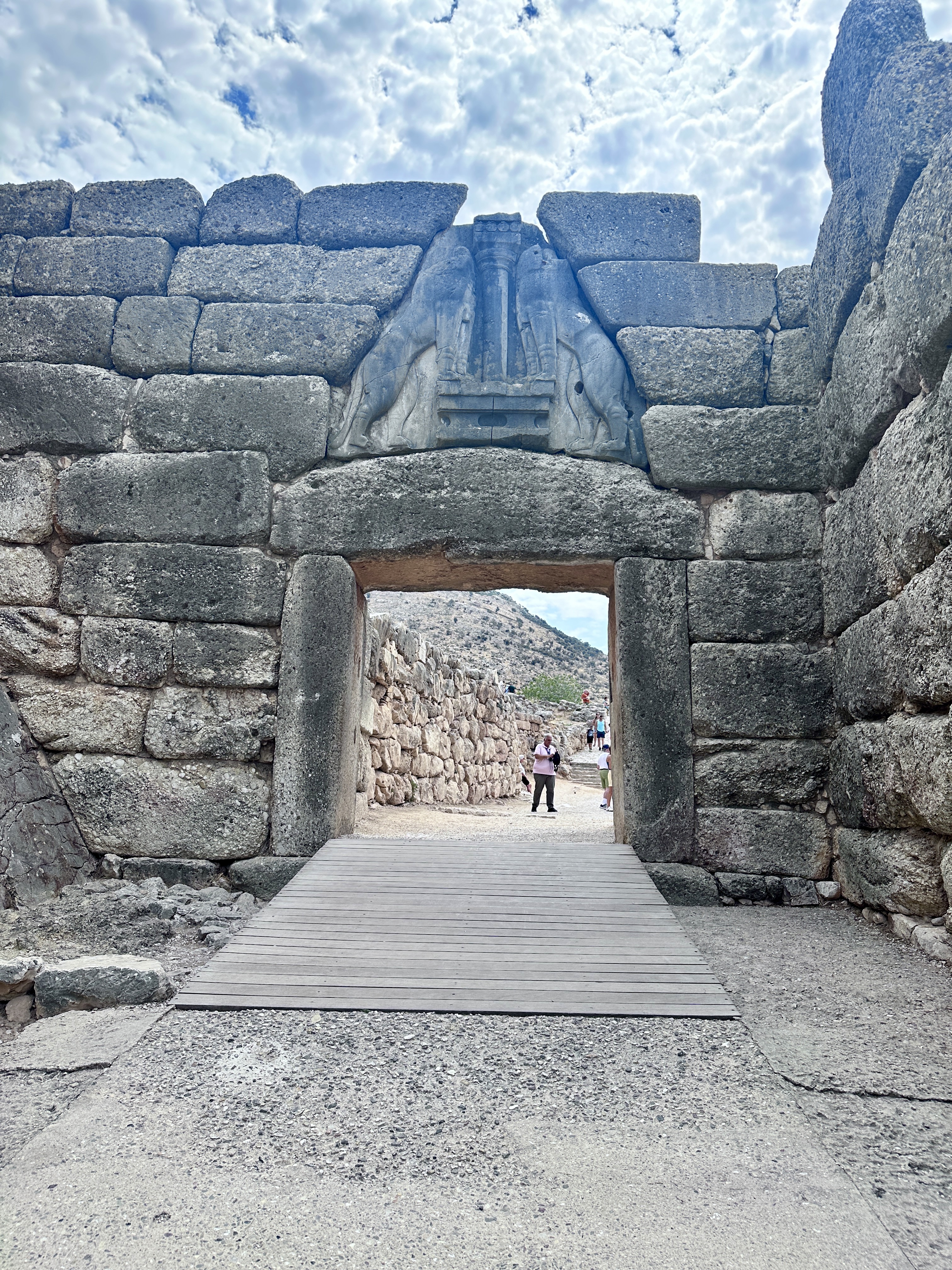
The Lion Gate is the popular modern name for the main entrance of the Bronze Age citadel of Mycenae in Southern Greece. It was erected during the thirteenth century BC, around 1250 BC, in the northwestern side of the acropolis. In modern times, it was named after the relief sculpture of two lions or lionesses in a heraldic pose that stands above the entrance.


Closeup of the Lion Gate. Notice the heads are missing. It’s believed the heads were pilfered at some point during raids.

The citadel of Mycenae, with its strategic position for the control of the Argolid Plain, is the kingdom of the mythical Agamemnon and the most important and richest palatial centre of the Late Bronze Age in Greece. Its name was given to one of the greatest civilizations of Greek prehistory, the Mycenaean civilization, while the myths related to its history, its rulers and their family members (such as Klytaimnestra, Ifigeneia, Elektra, Orestes) have inspired poets, writers and artists over many centuries, from the ancient to the contemporary times. Significant stages in monumental architecture are still visible in the property, such as the massive defensive walls, the corbelled tholos tombs and the Lions Gate.

Gathered for dinner, then off to bed as another full day of touring at Delphi tomorrow.

New Adventure! 23 days in the Eastern Mediterranean.


Yes, it's been a long time since anything has been written. We've been stationary in central Florida with Al working at Disney and me still working remotely. But we do need some adventure in our lives, and we chose to do a trip to the eastern Mediterranean the end of this summer. The itinerary above is the two-week cruise we did bookended between 4 nights in Athens to start and 5 nights in Tuscany/Florence, Italy, to end.

It was a fabulous trip from start to finish. I will be posting individual days and photos as fast as I can as I want to at least keep a record for myself. I'm not even sure anyone is still looking at this blog! But it'll be here for myself. If anyone out there reads it, I hope you all enjoy it!

Saturday, November 5, 2022

Grand European trip: Budapest, Hungary

10/8/22-10/9/22: Budapest, Hungary
Weather: sunny, cool to warm
Tours: Welcome aboard tour of neighborhood around docks on the Peste side
            Castle Hill District Hike
Exploration on our own of the Peste side including Parliament Building and area, St. Stephan's Basilica, pedestrian shopping/dining area

Note: You can click on any picture to make it larger.

10/8/22: Today was travel day from Prague to Budapest - pronounced Budapeszt. We learned there are 44 letters in the Hungarian alphabet due to combinations. The “s” is a combination of s and z. 
After boarding the longboat after the 7-hour bus ride through The Czech Republic, Slovakia, and Hungary, we went out on a short informational walk of the area near the boat dock. The guide was very funny and gave us a ton of information. We then did a quick look through some of the public areas of the boat, met up in the lounge for a drink and the welcome talk, and then had our first dinner in the Restaurant. There are 180 guests on board and everyone that we’ve met has been delightful. 
Tomorrow Al, Erin, and I have a morning hike of the Castle Hill district. So it’s off to bed!
In Hungary the public restrooms require payment. You put a one Euro coin in the slot and the turnstile lets you through. I thought it was hilarious. I will say, the restrooms were spotless, well appointed, and did not smell at all 😁

Outside of the Central Market, a huge farmer’s market open every day except Sunday. Of course, we’ll be touring Budapest on Sunday so we don’t get to see it open 😕.

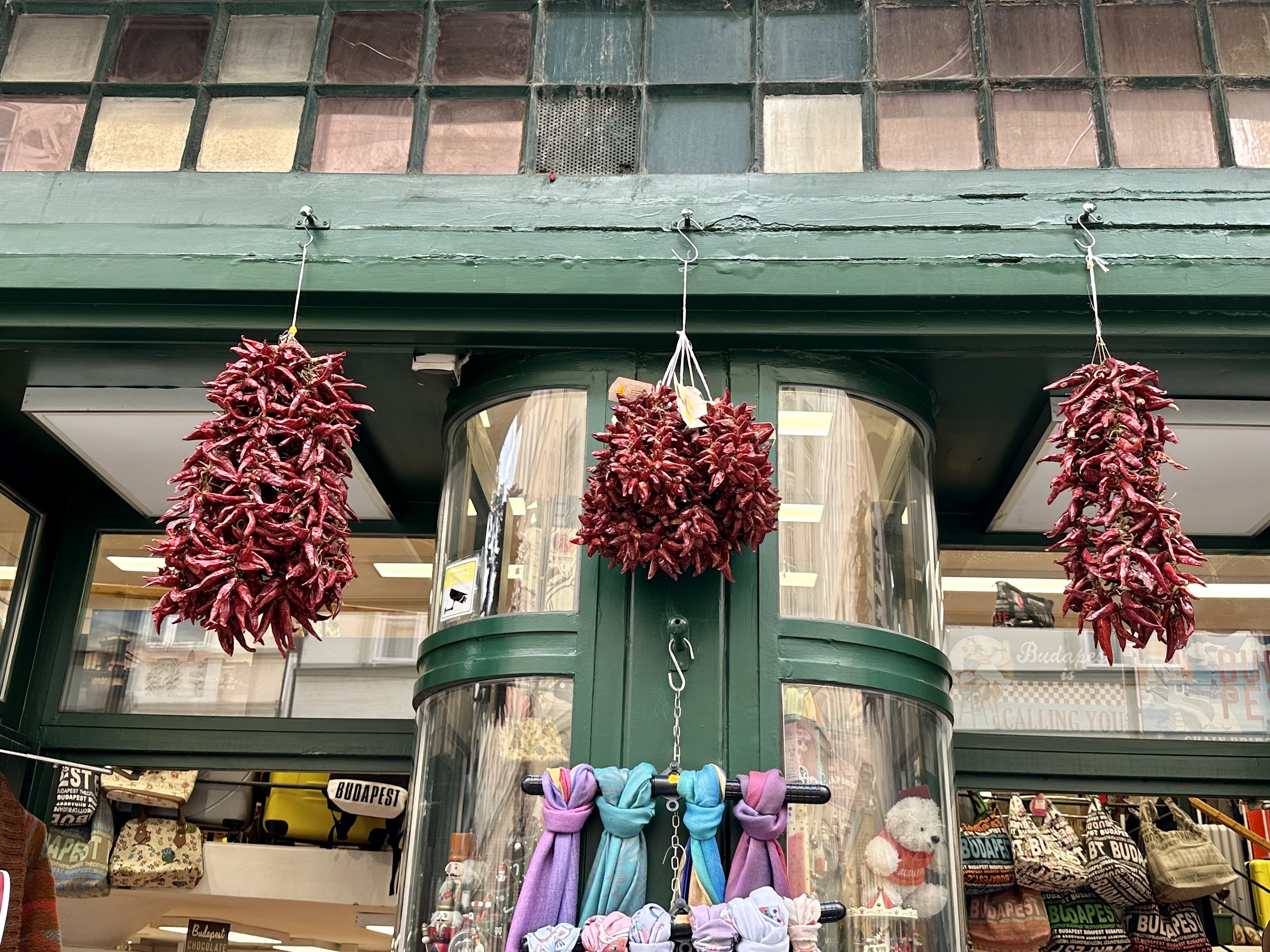
A popular product of Hungary is paprika. It’s for sale everywhere.

Pedestrian walkway in a retail/dining area. No cars allowed!

First dinner. Food was excellent. Off to a great start!
10/9/22: This was a big picture day! We did a hike of the Castle District, returned to the boat for lunch, then went out again to explore on our own. We returned in time for the boat’s departure at 6:15 for Vienna, Austria. We logged over 9 miles, 22,000+ steps!

The Liberty Bridge is the shortest bridge in Budapest's center. Initially built as part of the Millennium World Exhibition at the end of the 19th century, the bridge features art nouveau design, mythological sculptures and the country's coat of arms adorned on its side.

The northeastern house contains a museum on the bridges of Budapest. The bridge was the first in the city to be rebuilt after suffering heavy damage during World War II.

The statuette on the bridge represents Emperor Franz Joseph with his legendary mustache, arms crossed and military shako hat on his knees, sitting on a hammock that hangs from two padlocks. He's looking very thoughtful; maybe he's reflecting on the last rivet of this beautiful bridge, which he hammered down himself. 

The Liberty Statue
It was first erected in 1947 in remembrance of the Soviet liberation of Hungary during World War II, which ended the occupation by Nazi Germany. Its location upon Gellért Hill makes it a prominent feature of Budapest's cityscape. The 14 m tall bronze statue stands atop a 26 m pedestal and holds a palm leaf. Two smaller statues are also present around the base, but the original monument consisted of two more originally that have since been removed from the site and relocated to Statue Park. 
At the time of the monument's construction, the defeat of Axis forces by the Red Army was officially proclaimed “liberation”—leading to the original inscription upon the memorial To the memory of the liberating Soviet heroes [erected by] the grateful Hungarian people [in] 1945". Over the following years, public sentiment toward the Soviets decreased to the point of revolution, which was attempted and temporarily succeeded in 1956 and subsequently damaged some portions of the monument. After the 1989 transition from communist rule to democracy, the inscription was modified to read: "To the memory of those all who sacrificed their lives for the independence, freedom, and prosperity of Hungary". The Russian-language version of the tribute was removed in its entirety

The Cave Church in Budapest is inspired by Our Lady of Lourdes in France, built into the rocks and caves of the Gellért Hill. The church was established by Pauline monks. One hundred and fifty years after Joseph II banned the religious order from Hungary, fifteen monks that were exiled in Poland returned to Budapest and to the Cave Church. Finally, the monks were arrested during the Communist regime and the church was closed. After the departure of the Communist regime, it was reopened and still in use today.

Buda Castle Grand Bazaar

Buda Castle Royal gardens leading up to the escalator/elevator to the top! Buda Castle is the historical castle and palace complex of the Hungarian Kings in Budapest. It was first completed in 1265, although the massive Baroque palace today occupying most of the site was built between 1749 and 1769. The complex in the past was referred to as either the Royal Palace or the Royal Castle.

The Széchenyi Chain Bridge  is a chain bridge that spans the River Danube between Buda and Pest, the western and eastern sides of Budapest, the capital of Hungary. Designed by English engineer William Tierney Clark and built by Scottish engineer Adam Clark, it was the first permanent bridge across the Danube in Hungary. It was opened in 1849. It is anchored on the Pest side of the river to Széchenyi (formerly Roosevelt) Square, adjacent to the Gresham Palace and the Hungarian Academy of Sciences, and on the Buda side to Adam Clark Square, near the Zero Kilometre Stone and the lower end of the Castle Hill Funicular, leading to Buda Castle.
TheChain Bridge is also featured often in the television show FBI International.

Matthias Fountain is a monumental fountain group on the western forecourt of Buda Castle. Alajos Stróbl's Neo-Baroque masterpiece is 0ne of the most frequently photographed landmarks in the Hungarian capital. It is also referred to as the Trevi Fountain of Budapest.

Built in 1893, by Zala György, this bronze statue celebrates the freedom fighters, who fought, and in many cases also died, in one of the most important battles of The Independence War - the battle at the Buda Castle in 1848. The statue stands close to the Fisherman's Bastion. Although it is relatively small and inconspicuous, it is quite popular with the tourists. Dedicated to anonymous heroes, the statue's banner reads "Freedom or Death."

Local handicrafts

The Church of the Assumption of the Buda Castle (Hungarian: Nagyboldogasszony-templom), more commonly known as the Matthias Church (Hungarian: Mátyás-templom), more rarely the Coronation Church of Buda, is a Roman Catholic church located in the Holy Trinity Square, Budapest, Hungary, in front of the Fisherman's Bastion at the heart of Buda's Castle District. According to church tradition, it was originally built in Romanesque style in 1015, although few references exist.[2] The current building was constructed in the florid late Gothic style in the second half of the 14th century and was extensively restored in the late 19th century. It was the second largest church of medieval Buda and the seventh largest church of the medieval Hungarian Kingdom.
It is a historic building with an important history. Two Kings of Hungary were crowned within its walls: Franz Joseph I of Hungary and Elisabeth, and Charles IV of Hungary and Zita of Bourbon-Parma.
The church was also the location of the "Marian Miracle" of Buda. In 1686, during the siege of Buda city by the Holy League, a wall of the church - used as a mosque by the Ottoman occupiers of the city - collapsed due to cannon fire. It turned out that an old votive Madonna statue was hidden behind the wall. As the sculpture of the Virgin Mary appeared before the praying Muslims, the morale of the Muslim garrison collapsed and the city fell on the same day.

The statue of Saint Stephen has been standing in Buda Castle next to the Fisherman's Bastion for 115 years. Although the founding king of Hungary has always been highly respected in the country, the great work of Alajos Strobl was completed slowly. The first statue of King Stephen in Budapest was inaugurated in 1906 next to Matthias Church almost 40 years after it was first planned.


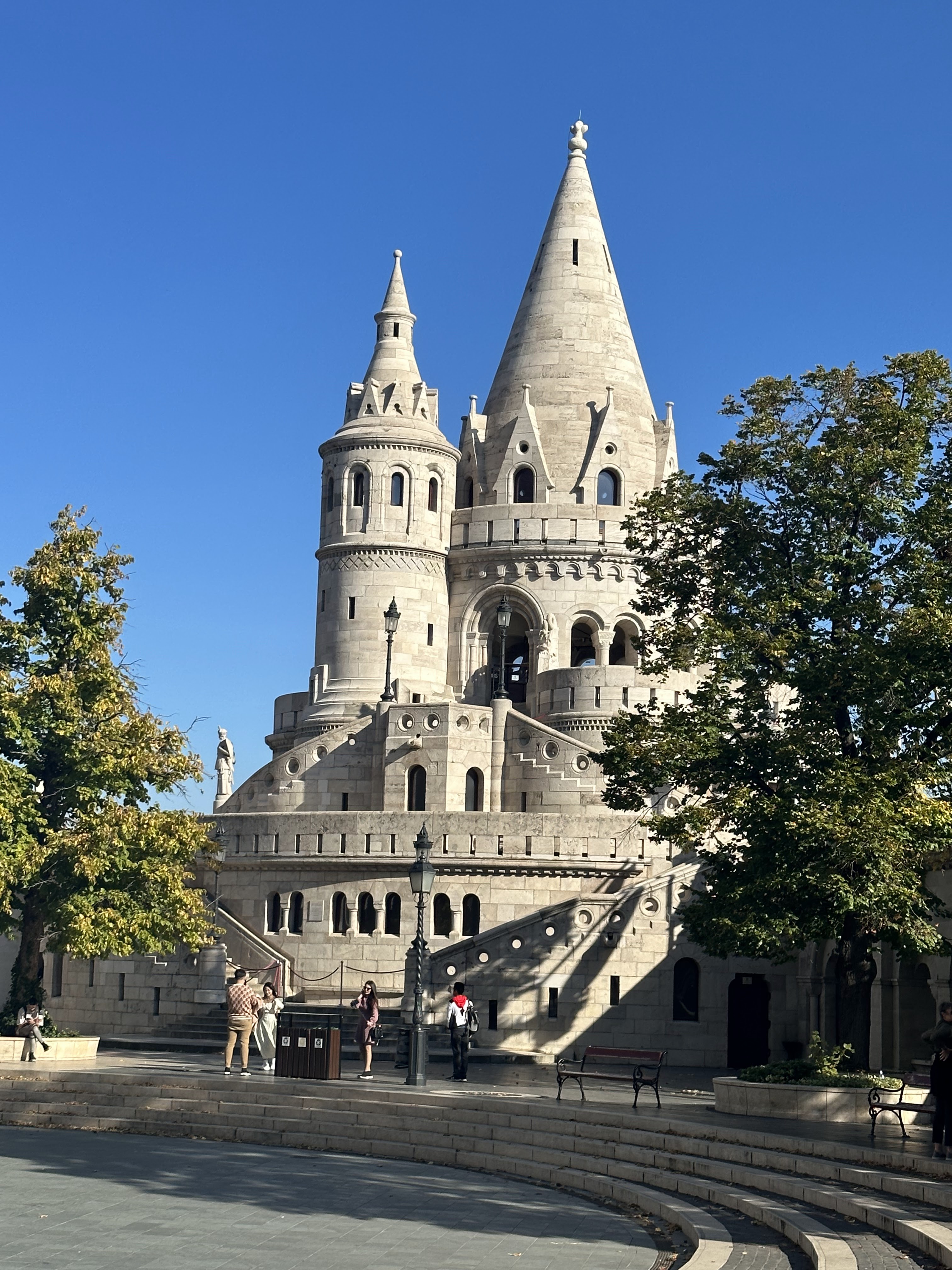
The Fisherman’s Bastion was built between 1895 and 1902 as part of the series of developments that were to celebrate the 1000th birthday of the Hungarian state. Consequently, the Bastion was inspired by the architectural style of the early medieval times (Neo-Romanesque) approx. the year 1000, when the first Hungarian king started his rule. What is more, the 7 towers of the Halaszbastya features the 7 Hungarian chieftains who had led their tribes to the present day Hungary to settle down in 895, and the Statue of St Stephen (1906), the first Hungarian king (1000-1038). In short, it is a historical monument for the millennial Hungary.

The Hungarian Parliament Building is the seat of the National Assembly of Hungary, a notable landmark of Hungary, and a popular tourist destination in Budapest. It is situated on Kossuth Square in the Pest side of the city, on the eastern bank of the Danube. It was designed by Hungarian architect Imre Steindl in neo-Gothic style and opened in 1902.[6] It has been the largest building in Hungary since its completion. Construction was started in 1885, and the building was inaugurated on the presumed 1,000th anniversary of the country in 1896. The keys to the building being handed over in 1902,[9] however, It was not fully completed until 1904.[10] The architect of the building first went blind and then later, died before its completion.


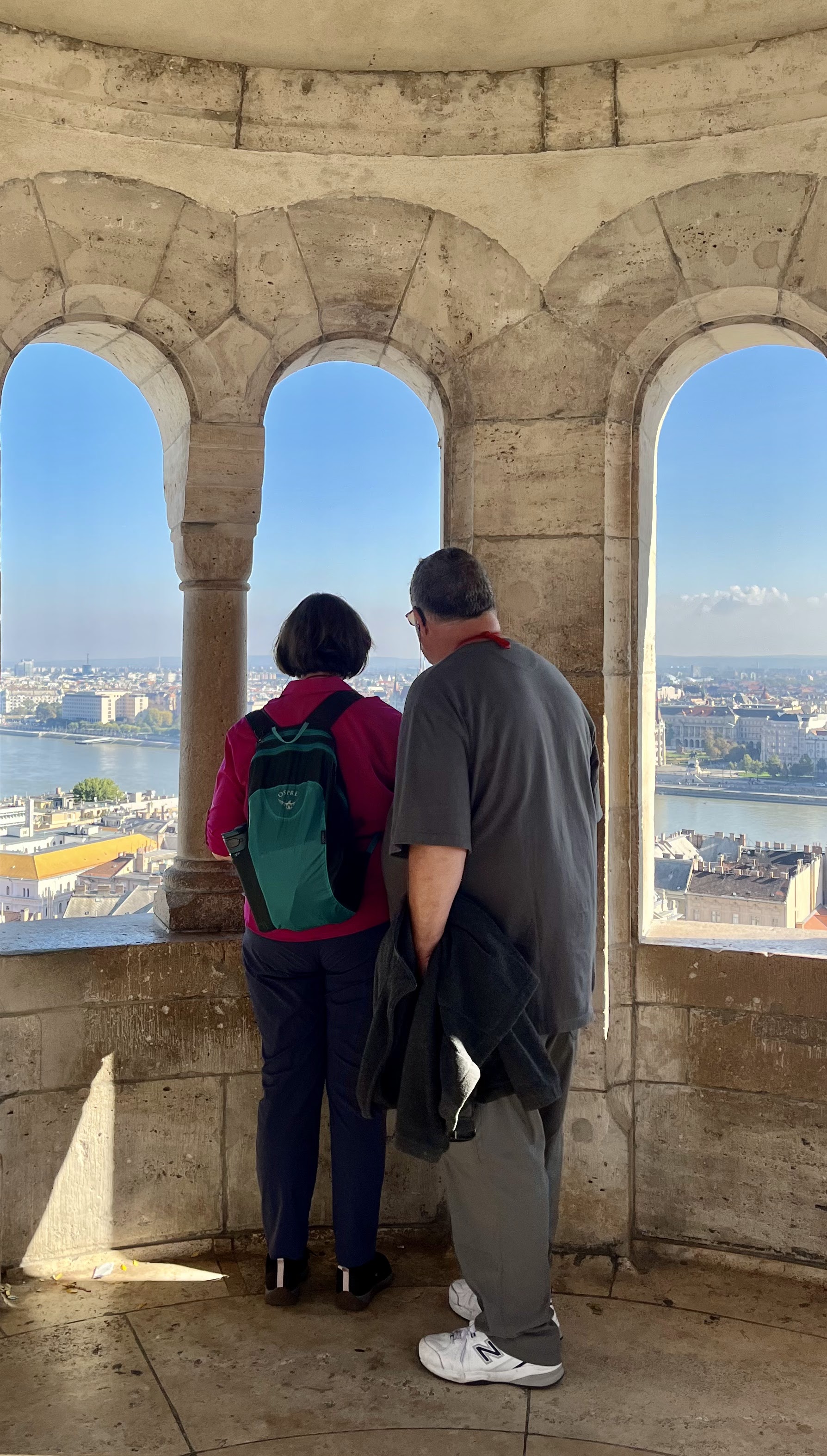
Fisherman's Bastion is one of the best known monuments in Budapest, located near the Buda Castle, in the 1st district of Budapest. It is one of the most important tourist attractions due to the unique panorama of Budapest from the Neo-Romanesque lookout terraces. The Fishermen's Bastion's main façade, parallel to the Danube, is approximately 140 meters long, of which the southern aisle is about 40 meters long, the north is 65 meters long, and the ornate central parapet is 35 meters long. 

Detailed sculptures atop the building that housed Budapest's Museum of Ethnology until its new home was completed in 2021.The Museum of Ethnology houses a splendid permanent collection on Hungarian traditional culture as well as various temporary exhibitions. Through its varied collection, the museum depicts the country's traditional culture and its citizens' way of life, including the different ethnic groups that existed in Hungary. The museum recreates everyday Hungarian life from the end of the 18th century until World War I.

Erin and I sitting on the front steps of the Parliament building for a sense of scale.

Closeup of one of the towers of the Parliament building. Unfortunately we were there on a weekend so we were unable to get tickets for a tour of the building. It's said to be amazing!


On the banks of the Danube River, just in front of the Hungarian Parliament Building, stand 60 pairs of iron shoes pointed towards the river. Poignant in their simplicity, a tragic story lies behind this memorial to the hundreds who lost their lives as a result of the atrocities committed by Budapest's Arrow Cross militiamen during the Second World War. The story is extremely moving and can be read here:
I really urge everyone to take the time to read it. It is just one of many tiny chunks of history that most people never know.

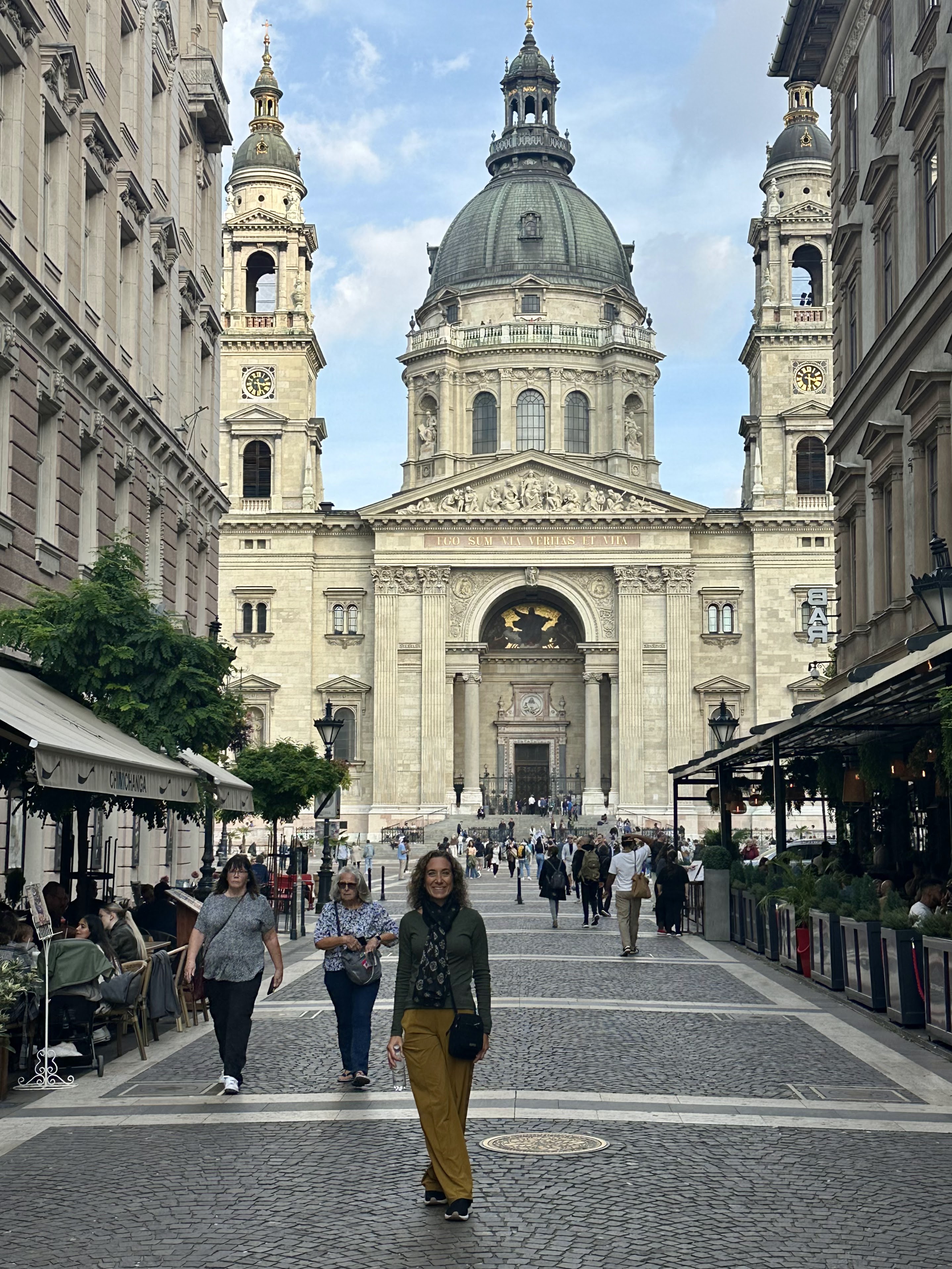
Erin is posing in front of St. Stephen's Basilica, a Roman Catholic basilica in Budapest. It is named in honor of Stephen, the first king of Hungary, c.975-1038, whose right hand is housed in the reliquary. It was the sixth largest church building in Hungary before 1920. Today it is the third largest church building in present-day Hungary.

Back on the boat, it was time to set sail up the Danube River to Vienna, Austria. So far, we're having an excellent adventure!


Thursday, October 27, 2022

2 Days in Prague, Czech Republic

Yes, I need to finish the Alaska/Canada posts, but I am interrupting those to journal our trip to Europe. Because as if the summer traveling Alaska and Canada wasn't enough, we also had a 3-week trip to Europe as well! Covid interrupted all plans, so we ended up with both trips in the same year. We have had a total blast on these trips, but I will admit that it's nice to be home and get back into a settled routine. 

So two weeks after arriving back in Florida, we departed Tampa to fly to our starting destination, Prague. We had 3 segments: Tampa to Atlanta to Paris to Prague. We started the journey October 4.

After being in airports for 24 hours, we finally made it to Prague. Full disclosure: air travel is no fun whatsoever. I haven't flown anywhere since 2016 and I thought it was bad then 😂. 
Anyhow, it went mostly smooth except for the itty bitty seats and crying baby behind us for, of course, the 8-hour leg. A short delay in departure at Charles de Gaulle airport but no worries. We had actually arranged our flights to give us plenty of time there as we had to take the airtrain from terminal to terminal, go through passport control - as we were coming from a nonShengen country to a Shengen country - and then go through security - and our USA TSA precheck status does not help outside of the USA. And with his new knee and implanted heart monitor, Al sets off all the alarms 😂.

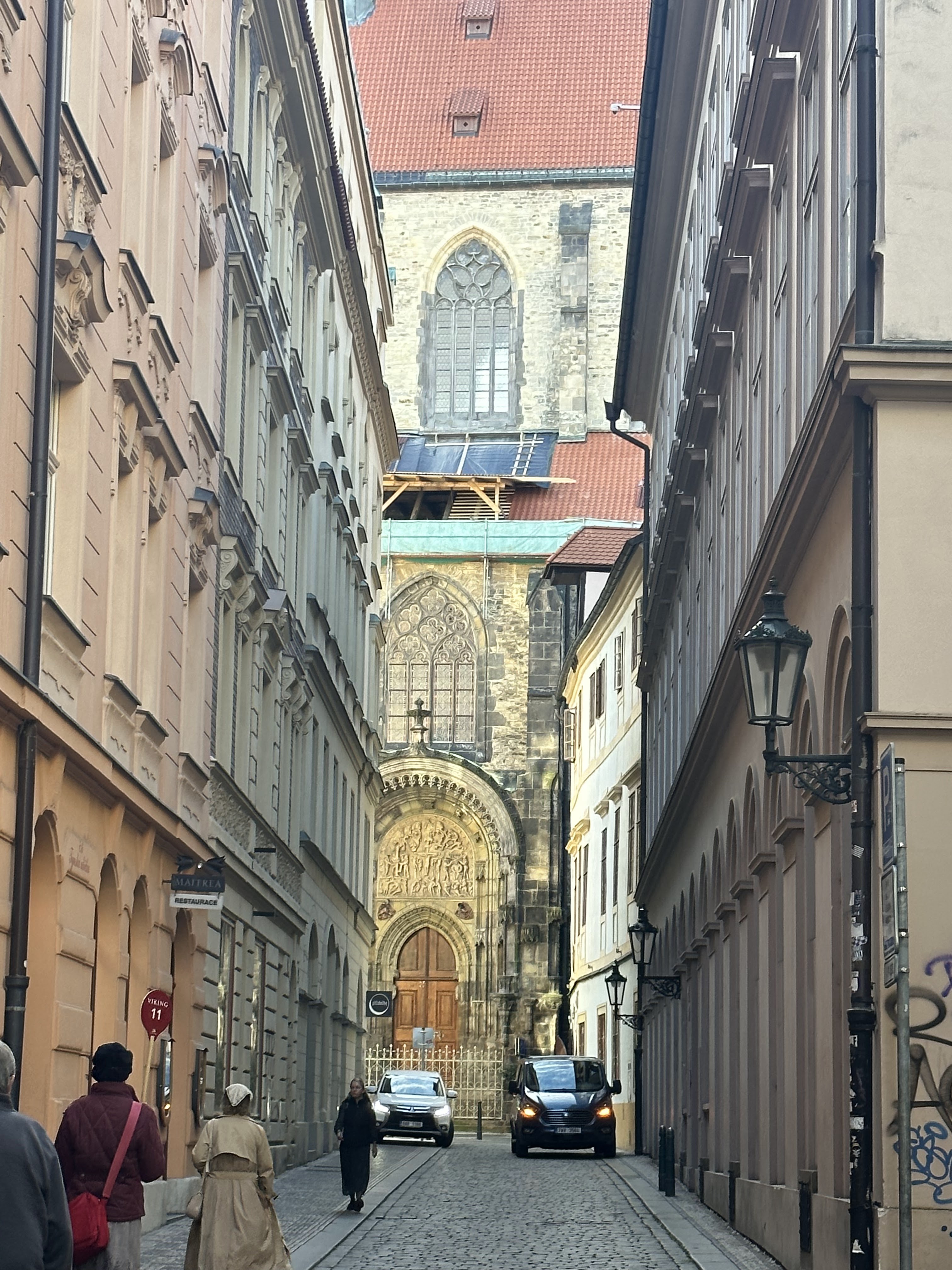
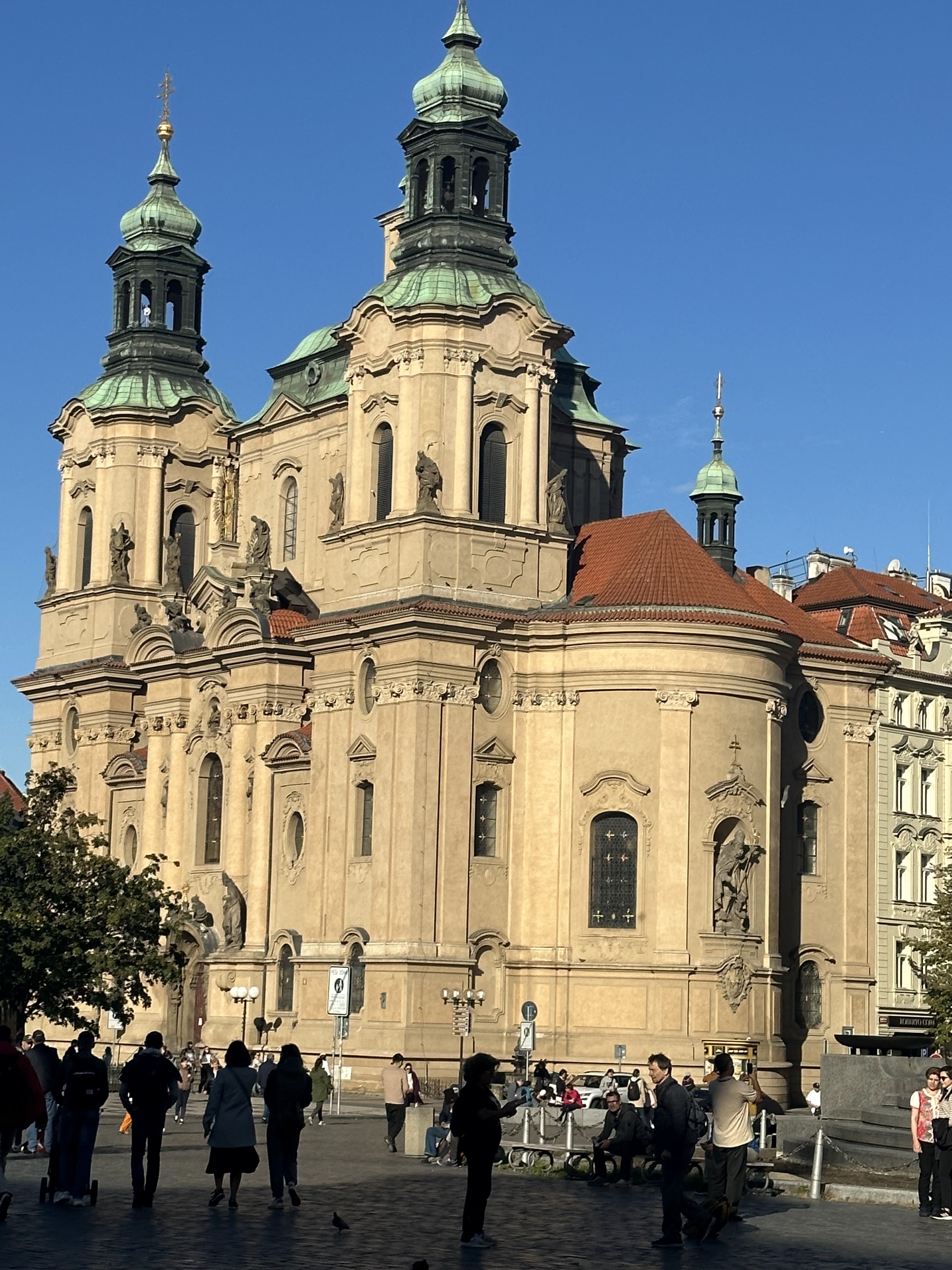
We arrived October 5 in Prague, Czech Republic, for three nights, staying at the Augustine Hotel. It's beautiful, actually inspired by and a part of the 13th century Augustine monastery which is interconnected with the hotel and has 4 monks still active there. They offer a tour of the monastery and the 13th century library together with the baroque St. Thomas Church, and I'm sure we'll find time for that.

Tomorrow we have a morning walking tour called Panoramic Prague, then the afternoon is free, and then we have a dinner cruise on the Vltava River that flows through the middle of the city. But first, sleep was needed!


Building from 1560

A highlight of our tour this morning was the Prague Astronomical Clock. From Wikipedia:

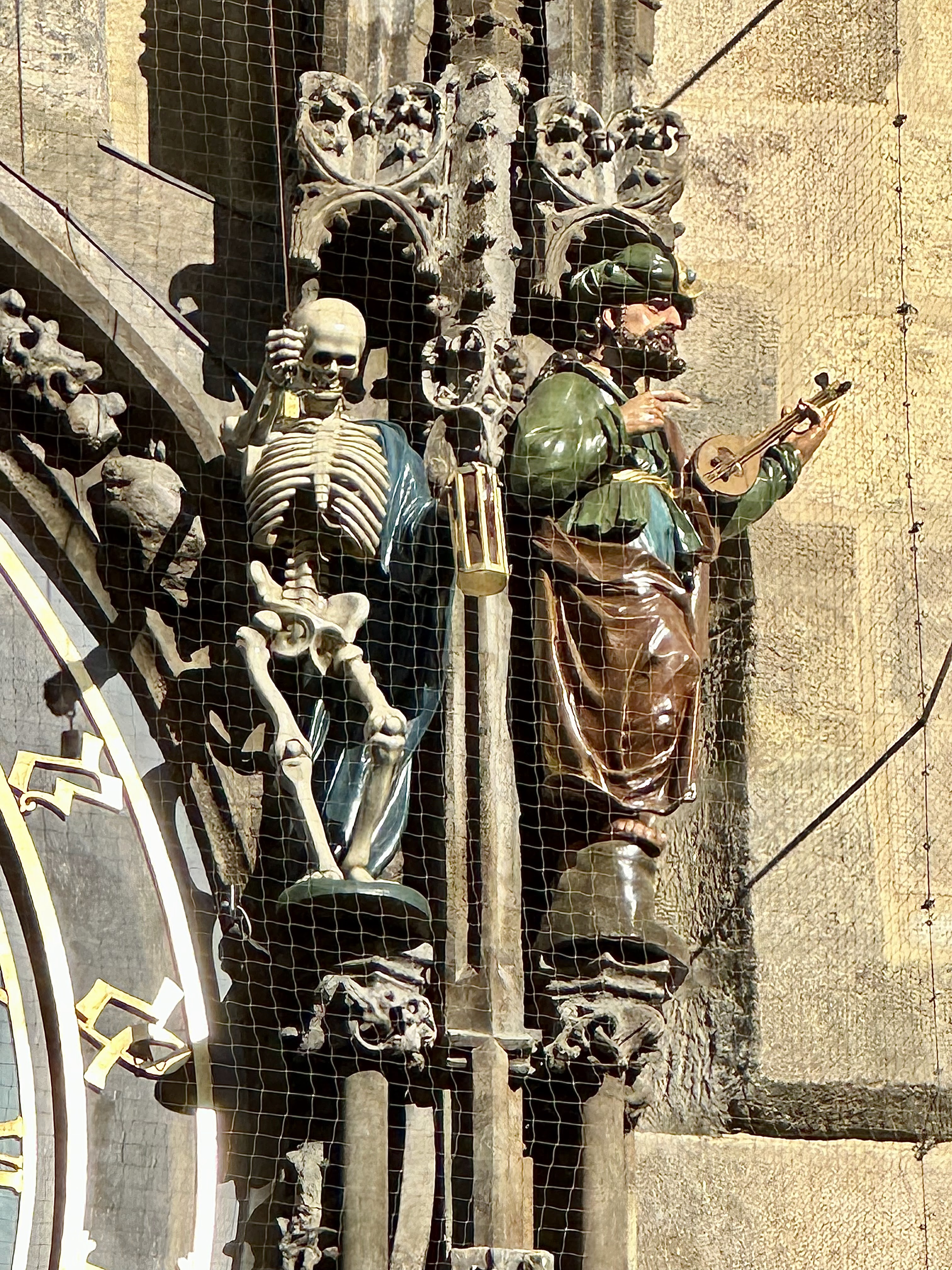
The Orloj is mounted on the southern wall of Old Town Hall in the Old Town Square. The clock mechanism has three main components — the astronomical dial, representing the position of the Sun and Moon in the sky and displaying various astronomical details; statues of various Catholic saints stand on either side of the clock; "The Walk of the Apostles", an hourly show of moving Apostle figures and other sculptures, notably a figure of a skeleton that represents Death, striking the time; and a calendar dial with medallions representing the months. According to local legend, the city will suffer if the clock is neglected and its good operation is placed in jeopardy; a ghost, mounted on the clock, was supposed to nod its head in confirmation. According to the legend, the only hope was represented by a boy born on New Year's night.

The oldest part of the Orloj, the mechanical clock and astronomical dial, dates back to 1410, when it was created by clockmaker Mikuláš of Kadaň and Charles University professor of mathematics and astronomy Jan Šindel. The first recorded mention of the clock was on 9 October 1410.[4] Later, presumably around 1490, the calendar dial was added and the clock facade was decorated with gothic sculptures.

In 1629 or 1659 wooden statues were added, and figures of the Apostles were added after a major repair in 1787–1791. During the next major repair in the years 1865–1866 the golden figure of a crowing rooster was added.

The netting surrounding the structure is in place to protect it from pigeons!


Wooden figures on the right side. Every hour the Walk of the Apostles occurs. The skeleton actually tolls the bell.


Year-round outdoor market that’s been in existence since 1232…can you imagine!?

Another highlight of yesterday’s tour of Prague is the Charles Bridge. Charles Bridge is the oldest bridge still standing over the Vltava river in Prague and the second oldest bridge in the Czech Republic. Charles IV had it built in 1357, after the previous bridge (had been destroyed by floods in 1342. The construction of the bridge was led by Peter Parler (“Petr Parléř” in Czech), the famous German-Czech architect, and it took almost half a century to finish it (It was completed in 1402). The bridge, formerly known as “Stone” or “Prague”, has only been called “Charles Bridge” since 1870. And until 1841 it was the only bridge over the Vltava river in Prague. 

Charles Bridge, spanning the Vltava river with 16 pillars, is rich in statues and decorative lamps, and it catches the eye immediately with its beautiful Gothic bridge towers on both ends.

The tower end leading to Old Town Prague and the Jewish Quarter.

The statue of Charles IV is an outdoor sculpture of Charles IV, Holy Roman Emperor, located at Křižovnické Square in Prague, Czech Republic.

There are 30 statues attached to the balustrade of the King Charles Bridge. The oldest unrestored statues are almost black, while the cleaned restored statues are tannish in color.

The end of the bridge leading to the newer section of Prague and the majority of the government buildings.

under the bridge is lovely as well.


John Lennon Wall. Located in a small and secluded square across from the French Embassy, the wall had been decorated by love poems and short messages against the regime since 1960s. It received its first decoration connected to John Lennon—a symbol of freedom, western culture, and political struggle—following the 1980 assassination of John Lennon when an unknown artist painted a single image of the singer-songwriter and some lyrics.[1]

In 1988, the wall was a source of irritation for Gustáv Husák's communist regime. Following a short-lived era of democratization and political liberalization known as the Prague Spring, the newly-installed communist government dismantled the reforms, inspiring anger and resistance. Young Czechs wrote their grievances on the wall and, according to a report of the time, this led to a clash between hundreds of students and security police on the nearby Charles Bridge. The liberalization movement these students followed was described as Lennonism (not to be confused with Leninism), and Czech authorities described participants variously as alcoholic, mentally deranged, sociopathic, and agents of Western free market capitalism.


Prague new town landscape from Charles Bridge. The castle on the hill is a separate district that we had hoped to tour, but the EU annual summit meeting is taking place this week and the district is closed to everyone not associated with the meeting.

Trdelník is a kind of cake. It is made from rolled dough that is wrapped around a stick, then grilled and topped with sugar and walnut mix. Of course having ice cream served in the hollow center only makes it more irresistible 😊

The King Charles Bridge at night as seen from our dinner cruise.

The Castle District at night.

Today we became more serious and took educational tours. The morning tour was called “Jewish Prague” and focused on the history of the extensive Jewish population. 
Jewish Quarter, also known as Josefov, is one of the most popular tourist destinations in Prague, located between the Old Town Square and the Vltava River. A Jewish ghetto was established here in the 12th century. At the turn of the 19th century, a large part of the ghetto was demolished. Fortunately, most of the significant buildings were saved from destruction and today, they represent the best preserved complex of historical Jewish monuments in Europe. 

The afternoon tour focused on the effects of WWII on the Czech Republic and Prague.  

I’ll try to put some of what we learned in the captions.
Both tours were very interesting and led by very well-informed guides. So far, I’m very impressed with the quality and wealth of knowledge that is imparted to our groups through these excursions.

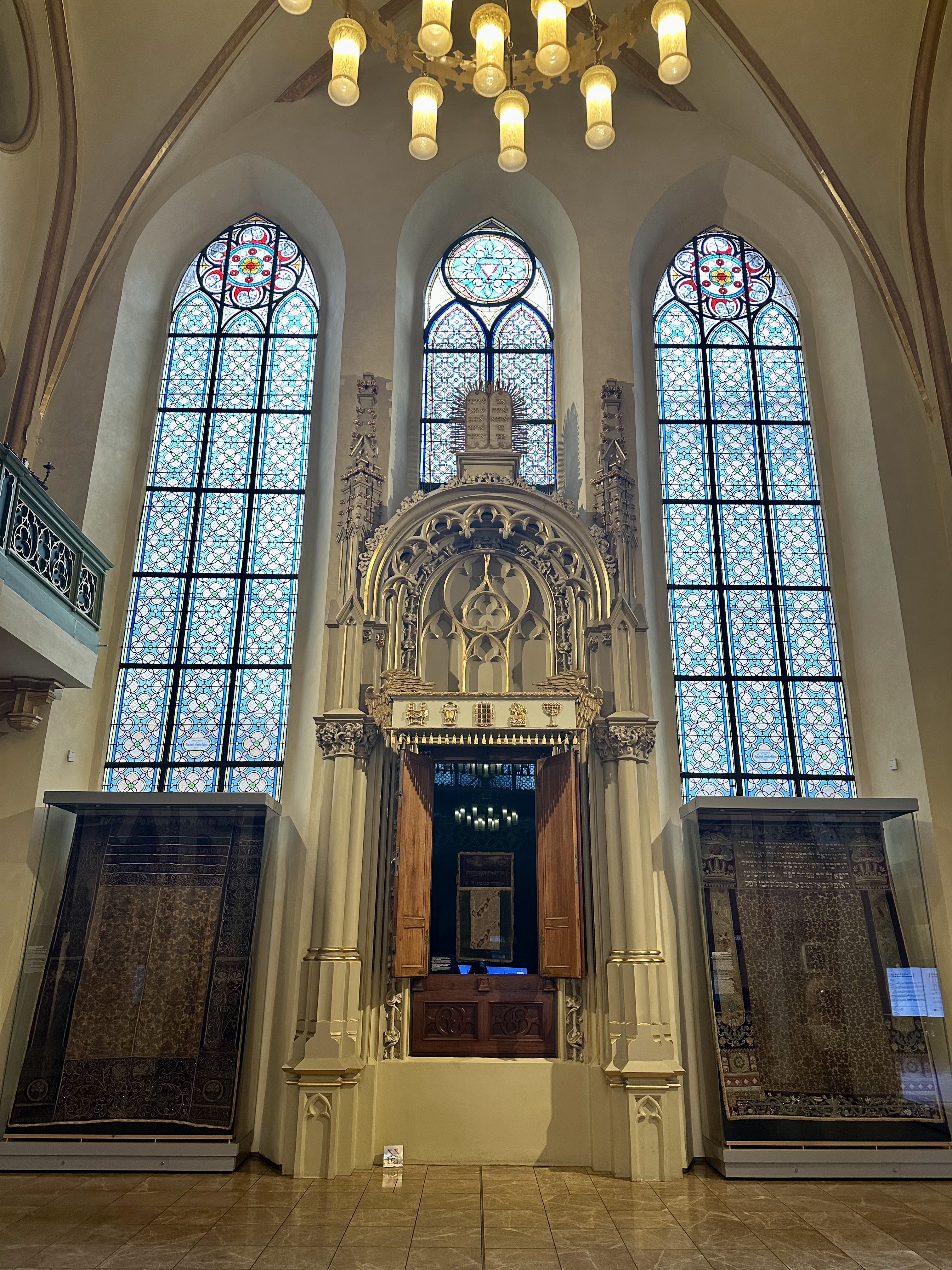
The Jewish Town Hall was basically built for the purposes of the Jewish community to provide offices for its employees. The synagogue next to the Jewish Town Hall is called the High Synagogue.

There are actually two clocks. Up on the tower there is a regular clock, and we heard the bells ringing, and down here is a Hebrew clock, which is very specific, as you have mentioned, because it goes from the right to the left.

The synagogue next to the Jewish Town Hall his called the High Synagogue.

As you can see, the three large Renaissance windows are on the first floor. That’s why it’s called the High Synagogue, because the first services were always held on the first floor, not on the street level.

The Spanish Synagogue is not the first synagogue at the site. Before it there stood probably the oldest synagogue in Prague Jewish Town, Altschule. In the second half of 19th century, the capacity of the Altschule did not suffice. The modernist faction in the community, which renovated it in 1837 for the purpose of moderately reformed services, therefore decided to demolish the synagogue in 1867 and one year later it was replaced by the new, Spanish Synagogue. Its name presumably refers to the style in which it was built, Moorish Revival style

The Prague Holocaust Memorial. Carved into the walls are the names, date of birth, date of deportation, and date of death and which concentration camp of each victim of the Nazi genocide. statistics: For the Czechs of the Protectorate Bohemia and Moravia, German occupation was a period of brutal oppression. The Jewish population of Bohemia and Moravia (117,551 according to the 1930 census) was virtually annihilated. Many Jews emigrated after 1939; approximately 78,000 were killed. By 1945, some 14,000 Jews remained alive in the Czech lands.[5] Approximately 144,000 Jews were sent to Theresienstadt concentration camp. Most inmates were Czech Jews. About a quarter of the inmates (33,000) died in Theresienstadt, mostly because of the deadly conditions (hunger, stress, and disease, especially the typhus epidemic at the very end of war). About 88,000 were deported to Auschwitz and other extermination camps. When the war finished, there were a mere 17,247 survivors. There were 15,000 children living in the children's home inside the camp; only 93 of those children survived.

Old Jewish Cemetery, one of the oldest surviving Jewish burial grounds in the world. No one knows when it was exactly established but the earliest known gravestone dates back to 1439 and belongs to Rabi Avigdor Kara, who as a young man, was one of the witnesses of the cruellest pogroms against the Jews in the history of Prague, which took place in 1389.

We traveled with our cousins, Bill and Denise, and their daughter Erin. We had a wonderful time!

Sampling lunch items at a cafe in Old Towne.

The Powder Tower is one of the original 13 city gates in Old TownPrague. Its construction began in 1475. The tower was intended to be an attractive entrance into the city, instead of a defensive tower. 
      The gate was used to store gunpowder in the 17th century, hence the name Powder Tower.

These are stumble stones, markers place in the sidewalk in front of a deported Jew’s residence. It commemorates their name, date of birth, deportation, and death at which concentration camp.

The residence of the family members memorialized in the above stumble stones. You can see them in the bottom right corner.


The afternoon tour was about the Czech Resistance to the Nazi occupation during WWII. The major story was about Operation Anthropoid, which is a long story that can be read about here: https://en.m.wikipedia.org/wiki/Assassination_of_Reinhard_Heydrich

It was a deep-dive into the politics of the time which was extremely interesting. At the end of the historical lead-up to why the resistance rose, we visited the church where the brave young men were hiding after the assassination attempts and where they were ultimately found and executed.


Parting photos from our last evening. 

Sampling Czechen beer


Next up: Travel to Budapest, Hungary, where we board our Viking longboat, the Skadi, for our 15-day river cruise.